
Akshi Parametric & Alternative Risk
A parametric MGA in 90 days.
The platform, the pricing evidence and the desk support to launch and run parametric and alternative-risk programs: hurricane, earthquake, weather and custom-index covers, and structured ART programs. You bring distribution and a capacity relationship. Akshi brings everything between the brief and the settlement.
Pricing studios
Vatya hurricane, Kampa earthquake, weather and custom-index pricing on AkshiSim evidence.
Sutra Re
Alternative risk transfer: captive layers, quota share, stop-loss, aggregates, multi-year terms.
Deal record
Structure, pricing basis, documentation, monitoring and settlement kept together.
For insurers, MGAs and brokers
From a decision to a live parametric program in one quarter.
Most of the time in a parametric launch goes to building what Akshi already runs: the catalogs, the pricing engines, the evidence file a capacity provider will accept, and the workflow that keeps a program reviewable. With those in place, the 90 days go to your product.
Weeks 1–3
Product design
Choose the perils and regions, design the triggers and payout ladders, and test basis risk against history and the AkshiSim catalogs. Draft wording and the operating procedure.
Weeks 4–8
Pricing and the capacity file
Technical pricing with named adjustments and uncertainty, a standardised submission that carries the model basis, and support through the capacity provider’s review.
Weeks 9–12
Go live
Quote, bind, monitor and settle on the platform. Akshi’s desk runs alongside your underwriters for the first programs; the record is yours from day one.
Desk-run. Akshi structures and prices; you distribute and bind.
Co-run. Your underwriters lead; Akshi supports structure, evidence and procedure for the first programs.
Self-run. Your team runs the studios, Sutra Re and the deal workflow directly.
Capacity
Akshi does not carry risk. Programs are placed with external capacity providers (insurers, reinsurers and ILS funds) on submissions that carry the model basis, selected adjustments, uncertainty ranges and the same pricing record used to prepare the indication. Bring your capacity relationship, or ask us who is writing the class.
For corporates and captives
Protect a balance sheet with cover that pays on the event.
Buy parametric cover
Cash within days of a measured event, with a public trigger instead of a negotiated loss figure: hurricane wind at a site, shaking at a plant, a temperature or rainfall window, or an index built from your own operating data. Akshi structures and prices it, then prepares the placement.
Self-insure through a captive
Retention pricing, layer design and multi-year program management for owners who want an alternative to a hardening market. Priced on your loss history with credibility blending, and documented so a board, an auditor or a regulator can follow it.
Energy and weather exposure
Temperature, demand and generation exposure priced from station history or your own data: degree-day structures, index covers and season-accurate settlement. Where it helps, paired with Akshi Energy for the market view.
Exposures outside these are considered case by case. Send the details →
The platform under the desk
Specialist modules, one underwriting record.
Hurricane, earthquake, weather, custom index, Sutra Re, and portfolio operations each have dedicated workflows. Pricing evidence, documentation, monitoring, and settlement remain connected to the same deal record.
Track intelligence, trigger design, and wind pricing
- IBTrACS historical tracks with AkshiSim catalog evidence
- Circle, ring, polygon, and track-gate trigger designs
- Wind speed, Saffir-Simpson category, pressure, and crossing-intensity views
- Credibility adjustments where catalog limitations are known
- OEP/AEP curves, sensitivity runs, technical price, and quote workflow
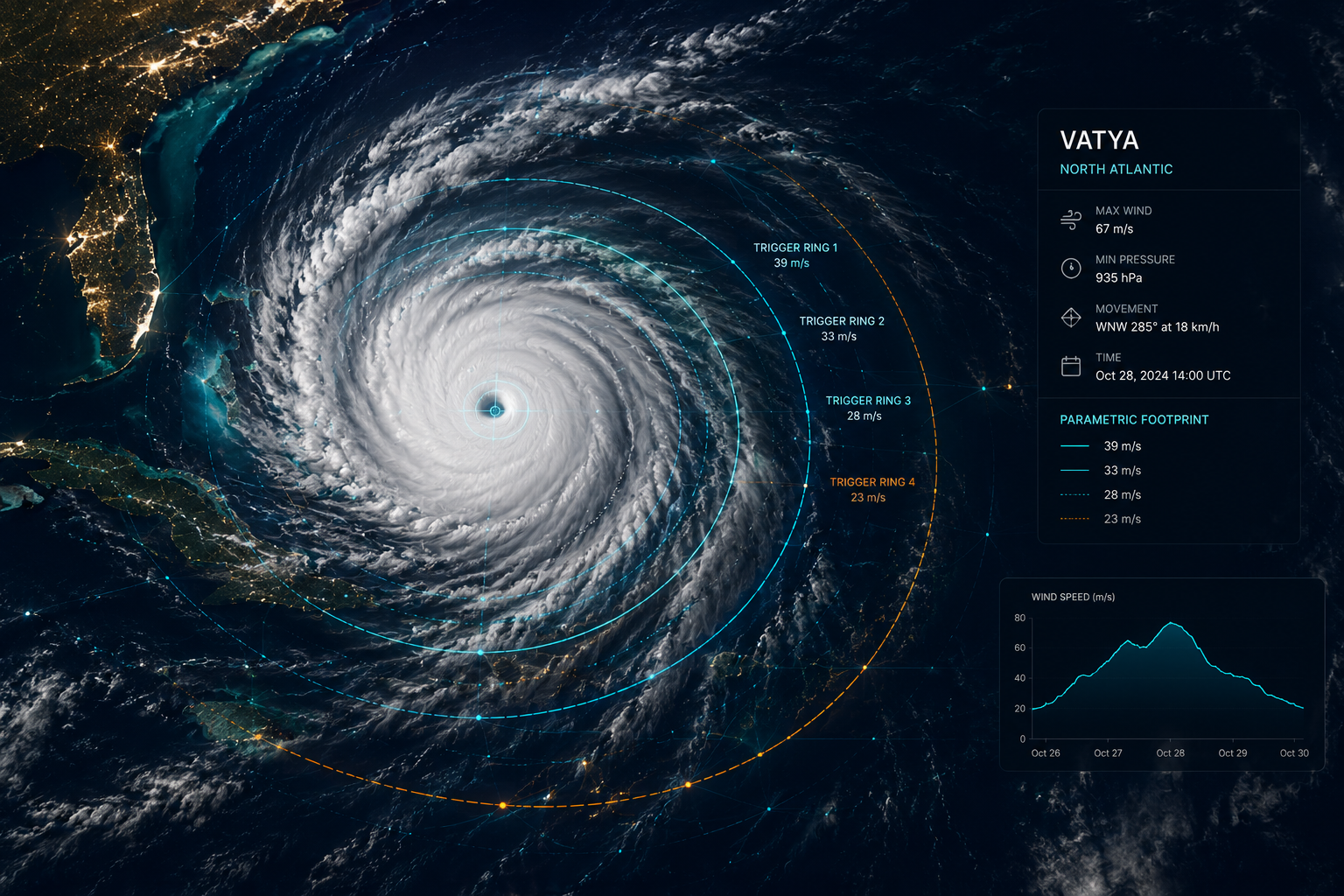
Vatya Wind Pricing
A live hurricane resolved into a parametric footprint — trigger rings, wind-speed history, and category bands, ready to structure and price.
Evidence and governance
A transaction file that can be reviewed.
Akshi keeps the structure, data, pricing basis, selected adjustments, and model caveats attached to the deal record. The aim is simple: a reviewer should understand what was priced, why it was priced that way, and what remains uncertain.
Structure
Trigger, attachment, payout, term, renewal mechanics, and settlement source.
Pricing basis
Historical burn, simulated view, fitted assumptions, and named adjustments.
Review record
Model basis, credibility flags, override reasons, caveats, and version history.
The desk's method
From brief to settlement.

An exposure, a loss run, or a structure under review.

Candidate designs with basis risk assessed at the design stage.

Model output, calibration, credibility, and uncertainty shown as named inputs.

A termsheet and submission file prepared from the same record.

Monitoring, settlement, and renewal repricing tied to stored terms.
Examples
From brief to a documented decision.
These examples show how a brief becomes a structure, a pricing view, and a documented underwriting decision.
All examples are illustrative. No real client data, testimonials, or achieved outcomes are represented.
Gulf Coast wind · $6M limit
IllustrativeProblem
A coastal hotel group with $40M of Gulf exposure needs cash within days of a hurricane — for payroll and repairs, before a loss adjuster ever arrives. They want a public, indisputable trigger, not a negotiated economic-loss figure.
Structure
150 km cat-in-a-circle around Biloxi, MS paying $2M at Cat 3, $4M at Cat 4, and $6M at Cat 5. The same risk is re-cut as a ring and a track-gate to compare basis risk before quoting.
Evidence
163 years of IBTrACS tracks beside a 1,000-year AkshiSim catalog put the Cat 3+ trigger near a 6.8% annual probability, with OEP 1-in-50 at $4.8M and a credibility flag on the Gulf zone.
Decision
Model EL $0.31M, a 1.8× technical loading, and review checks — all versioned to the deal — before bind. Illustrative only.

Start with one product, or one risk.
Tell us the program you want to run or the exposure you want covered. You will get structure options, indicative pricing and the evidence behind them.